Articles
A hole in your painting? Here is how the canvas can be repaired and the paint recovered
A hole or tear does not mean a painting is lost. Learn how a canvas is stabilised and missing paint is reconstructed.
Message me on WhatsApp →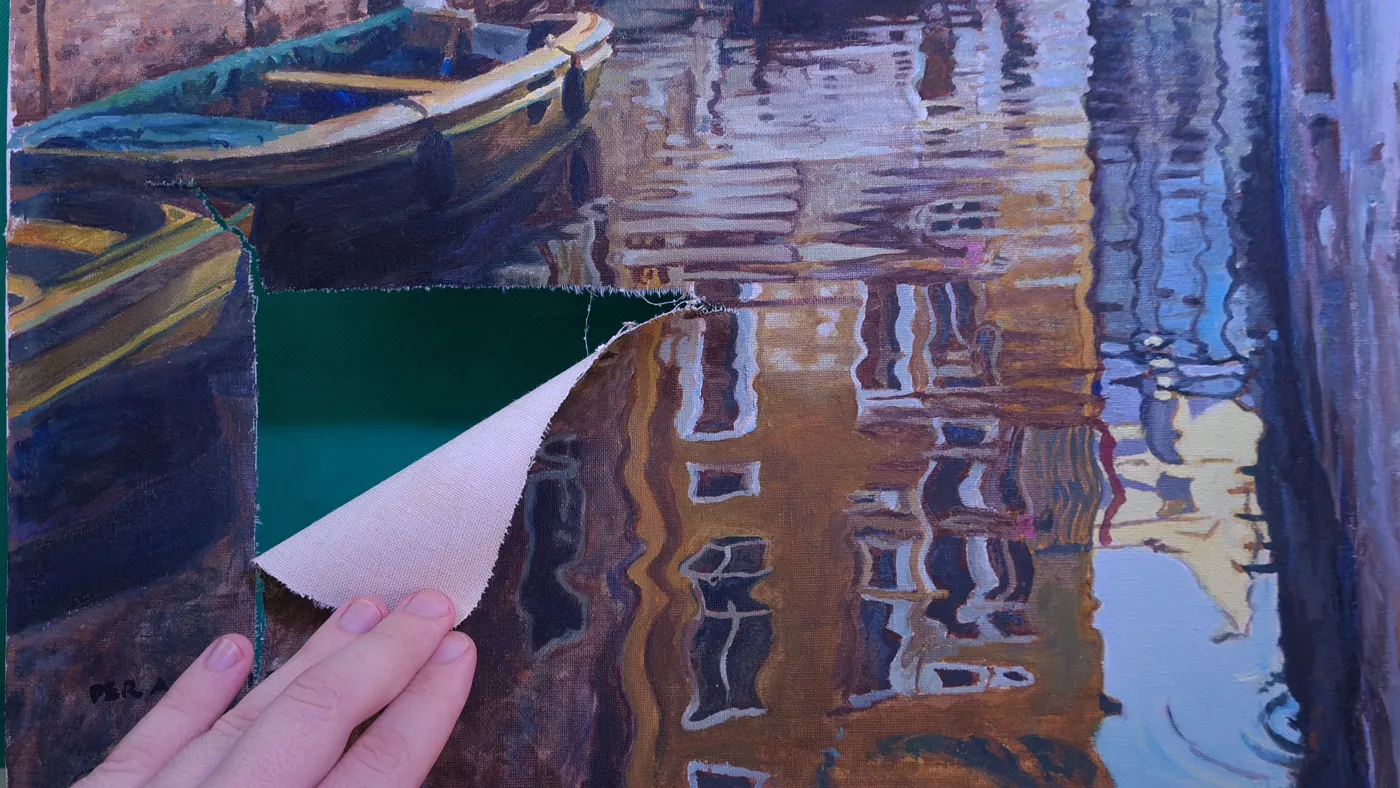
A torn canvas, an accidental puncture or a flake of detached paint does not mean the painting is beyond saving. Even when the canvas fibres are broken and part of the image is missing, professional techniques can restore both the structure and the work’s original appearance.
If you are looking for a professional solution, you can commission Alex Víctor Ihnatenko to repair your painting, a Barcelona-based restorer specialising in damaged canvases and the reconstruction of paint losses. The initial assessment is free.
What not to do with a torn canvas
One of the most common mistakes is trying to glue the canvas with household white glue. The problem is not simply the adhesive; it is the lack of control over its composition, penetration and rigidity once dry. An unsuitable product can stiffen the fibres, leave residue and make later restoration more difficult.
You should also avoid putting adhesive tape over the tear. Many commercial adhesives age, become sticky or leave stains. Tape can also cause further distortion of the fabric.
Another mistake is using household filler to fill holes. A painting on canvas is a flexible structure that responds to environmental changes. A fill that is too rigid may crack or detach from the surface.
Finally, do not try to reposition the fibres or pull the edges by hand. A small distortion can become permanent.
How the structure of a damaged canvas is restored
Professional restoration begins by examining the strength of the fibres and the condition of the paint around the tear.
In some cases, the ends of the original threads can be brought together with specific adhesives. When fibres are missing or there is considerable tension, local supports or textile inserts may be needed.
The choice depends on the age of the fabric, its flexibility and the type of tear. A repair that is too rigid is not desirable either: the aim is to create a strong join whose mechanical behaviour is compatible with the rest of the canvas.
Once the canvas is stable, losses in the ground and paint layers are reconstructed. This stage requires particular precision, because restoring the colour alone is not enough; the original texture must also be recreated.
A traditional technique refined over centuries
One distinctive aspect of Alex Víctor Ihnatenko’s work is the combination of contemporary conservation procedures with knowledge drawn from different European restoration traditions.
One of these is levkas, a term derived from the Greek λευκός and used for a traditional ground particularly associated with Eastern European icon painting.
Unlike a simple fill made from mineral powder and water, traditional levkas grounds contain a binder and, depending on the recipe, components that affect their flexibility and working properties.
This tradition developed and was refined over centuries in regions where religious paintings could be exposed to substantial seasonal changes in temperature and humidity.
Knowledge of these formulations allows Alex to adapt certain materials for precise work reconstructing small losses, modelling textures and levelling surfaces.
In his Barcelona studio, this experience is combined with modern conservation adhesives, specialist materials and localised intervention methods. The result is a broader range of techniques for addressing problems that cannot always be solved with a single standard approach.
Restoration for private collections and historic spaces
Alex’s experience includes work on historic paintings, family heirlooms and private collections, including interventions connected with Herboristeria del Rei in Barcelona, which houses works associated with the stage designer Francesc Soler Rovirosa.
Paintings displayed in historic commercial spaces do not always benefit from the controlled environmental conditions of a museum. Material compatibility, treatment stability and long-term preservation therefore form part of the planning for each intervention.
Owners of paintings restored by Alex have particularly highlighted the quality of the materials used, the attention to detail and the respect shown for the original works.
Can a painting be repaired so the tear is no longer visible?
In many cases, reconstructing the fibres, filling losses and reintegrating colour can produce a result that is very discreet visually. The difficulty depends mainly on the extent of the damage, the original texture and how much paint is missing.
If your painting has a hole, cut or tear, you can send photographs of both sides of the work to learn about the repair options and receive an initial estimate.