Articles
How to choose a professional painting restorer in Barcelona
How to choose a painting restorer in Barcelona: experience, materials, budget and signs of trust to look for before commissioning a restoration.
Message me on WhatsApp →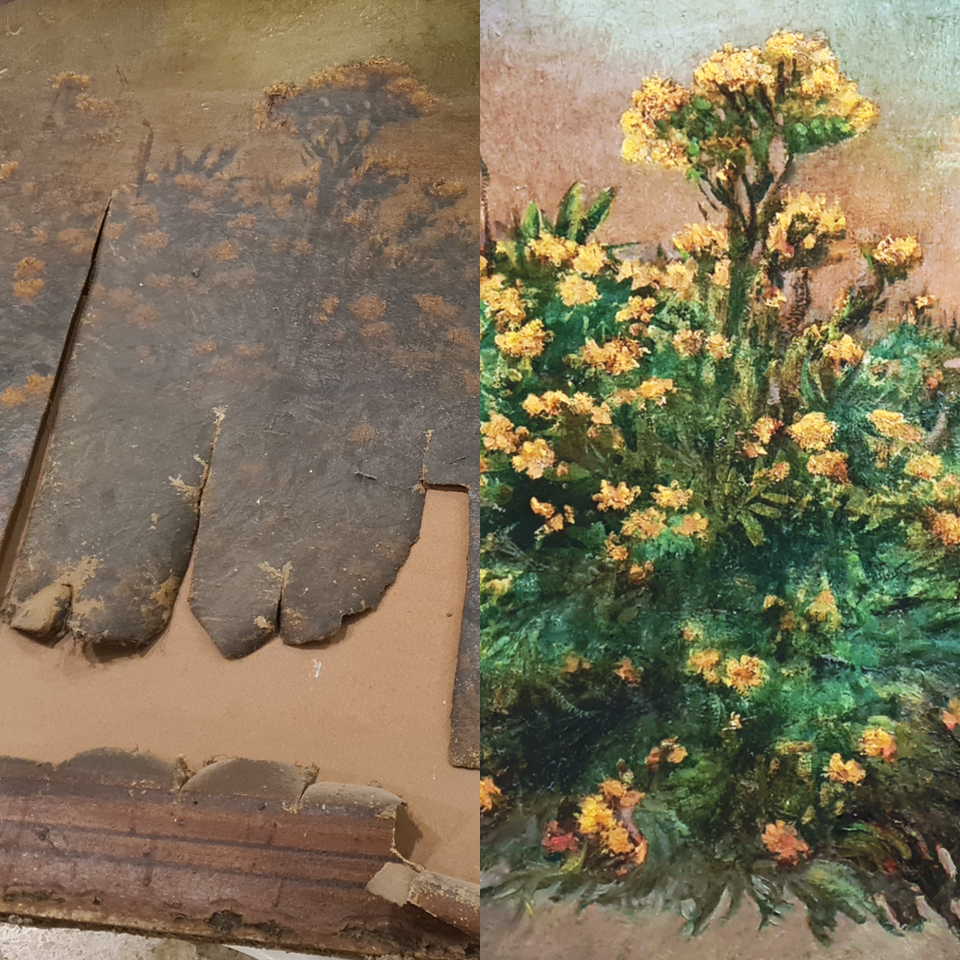
Specialist training, completed projects and membership in professional associations are a good starting point when choosing a professional painting restorer in Barcelona. But once you have checked the basics, what distinguishes someone who will apply a routine solution from someone who can find the one best suited to your painting? Other, less obvious factors matter too: experience with different materials, the ability to adapt the work to your budget, a commitment to continued learning, and the questions asked before work begins.
1. Looking beyond oil painting
A painting is not always oil on canvas. It may be painted on wood, glass or an unusual support, combine different materials, or conceal previous repairs.
That is why experience in disciplines such as mural painting, stained glass or sculpture can provide useful skills. A professional accustomed to examining different supports may notice problems and suggest alternatives that are less obvious when someone always works with the same type of object.
Consider a painting on glass: understanding the paint layer is essential, but so is understanding how it behaves on a smooth, non-absorbent surface. Experience with glass can complement a specialization in painting, although working with stained glass does not automatically make someone a specialist in painting on glass.
A useful question is: “Have you worked with materials or problems like those in my painting?” The answer will tell you more than a long list of services.
2. Flexibility to find a workable solution
Some colleagues may disagree, but I believe a restoration should also take into account the circumstances of the person commissioning it. Someone who wants to restore a family painting on a limited budget needs clear, workable options.
Not every painting needs a full restoration. Sometimes a localized problem can be addressed and the appearance of the work greatly improved without tackling every issue at once. In other cases, it makes sense to divide the work into stages and begin with what will prevent further deterioration.
Flexibility means knowing what can be simplified, what can wait and what is essential. If paint is actively flaking, for example, that instability must be addressed before the painting’s appearance can be improved.
There is room for creativity in developing a solution, as long as the original materials are respected and the limitations are explained. Adapting the scope of work to a budget is a professional skill; hiding a problem beneath cosmetic improvement does not solve it.
Ask whether there are different options and what result you can expect from each one.
3. A professional who keeps learning
Experience matters, but so does the effort made to keep it current. Some materials and procedures used twenty years ago have been revised or replaced; others remain useful when applied in the right context.
A restorer who reads specialist publications, attends courses and exchanges knowledge with other professionals has more ways to respond to a problem. Learning about a new product also means studying its limitations and considering how it may behave over time.
Test swatches, sample boards and prepared samples allow materials to be compared before they are considered for use on an artwork. Your painting should not be used to try out an unassessed idea.
Training at different academies or with different teachers can also provide complementary perspectives. What matters is being able to compare those approaches and choose the one best suited to the work, rather than applying the same recipe every time.
4. A price that matches the proposed work
The cost of restoring a painting depends on the time, materials, difficulty and expertise involved. Size plays a part, but a small, fragile painting may need more attention than a large canvas in good condition.
Can professional work be done for €100? A small, clearly defined treatment can be perfectly reasonable. What deserves scrutiny is a supposed full restoration of a badly deteriorated work for the same amount.
When a budget does not allow enough time, there is a risk of taking shortcuts: covering damage, repainting more than necessary, or using materials simply because they are readily available. An improvised repair with household glue and a scrap of fabric may seem inexpensive today and complicate future treatment.
The figure alone does not prove quality. The relationship between the price, the painting’s condition and the work included should make sense. Before comparing estimates, check that they propose a similar scope.
5. The ability to explain limits and say “I wouldn’t do that”
Another sign I value is a restorer’s ability to set limits on their own proposals.
For example, a photograph may show a yellowed painting, but it cannot always reveal how much is caused by surface dirt, varnish or changes in the paint itself. Promising that specific colours will return before examining the work can create impossible expectations.
A professional should explain what they can see, what still needs to be checked and what result they consider realistic. They should also be able to recommend preserving a mark of age or stopping a cleaning process when continuing would put the original at risk.
Be wary of promises to make every painting “look like new.” The goal should be agreed based on the work you have, its technique, its history and its current condition.
6. Clarity before, during and after restoration
Before leaving your painting at a studio, it is sensible to have a written description of the proposed work, its cost and what will happen if problems arise that could not be seen at the outset.
Photographs and a record of the treatment help you understand the work carried out and provide useful information for the future. It is also worth asking how to transport the painting, where to display it and what care it will need afterwards.
Trust is built through clear explanations. You should be able to understand what you are commissioning without having to become a specialist.
Looking for a painting restorer in Barcelona?
If you have a deteriorated painting and are not sure where to start, you can send me photographs of the front, the reverse and the damage, together with its dimensions. Also tell me what you would like to improve and whether you have an approximate budget.
With that information, I can give you an initial assessment and explain what would need to be checked in person before I prepare a specific proposal.
Visit my painting restoration service in Barcelona for more information and to get in touch.
Alex Victor Ihnatenko