Articles
The sentimental value of an old painting: is it worth restoring?
A family painting may have little market value yet be irreplaceable at home. Learn how to weigh restoration options and work within a budget.
Message me on WhatsApp →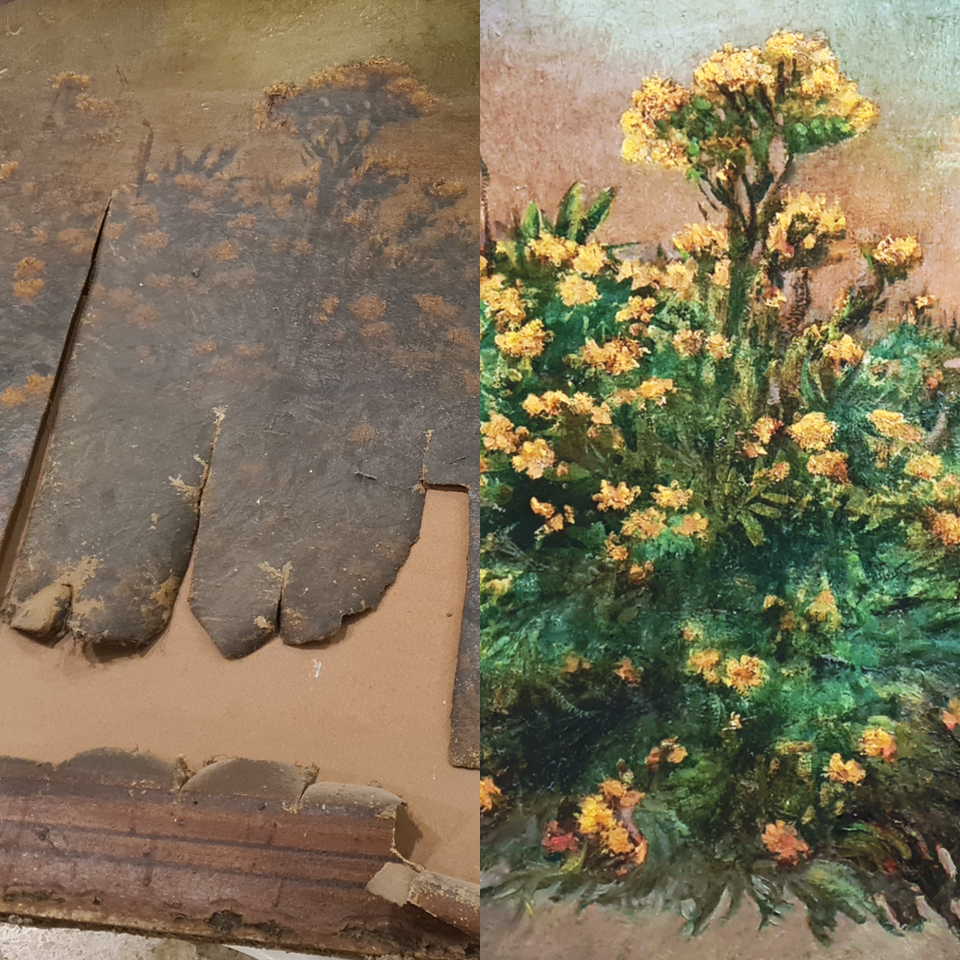
Some paintings never appear in auction catalogs. They have no famous signature, are not insured for large sums, and might not fetch much money. Yet for a family, they can be absolutely irreplaceable.
It might be the landscape that hung in your grandparents’ home, a portrait passed down through several generations, or a painting you remember from childhood. In these cases, the sentimental value of an old painting does not necessarily reflect its market value.
Is it worth restoring a painting with little monetary value?
A common question is: “If the painting isn’t worth €400, does it make sense to spend €400 restoring it?”
The answer depends on what it means to you and what the artwork needs. If you only plan to sell it, you will probably compare the cost with its market price. But if you want to keep it at home and pass it on to your children, the calculation changes.
A €400 restoration, hypothetically spread over 50 years of enjoyment, works out to about 2.2 euro cents a day.
Two cents a day to keep seeing a painting that belonged to your grandparents. To preserve something your parents looked at as children. To retain a small part of your family’s history instead of replacing it with a reproduction that holds no memories.
This calculation is a way of considering the expense over time, not a guarantee of longevity: future preservation will depend on the materials, the painting’s condition, its environment, and its care.
Monetary value and family value are two different questions
An appraiser can study authorship, provenance, period, and the market. A restorer examines something else: the painting’s stability, the damage that can be treated, and the risks of intervention.
A painting does not need to become a financial investment to deserve preservation. Family memory is a perfectly valid reason too.
And there is an important difference between buying a similar painting and preserving that particular painting. Even if you find an almost identical landscape, it will not be the one that hung in your home for decades.
A complete restoration is not always necessary
Sometimes the priority is not to recover every color and fill every loss immediately. It is to stop paint from continuing to flake off, stabilize a tear, or address a problem with the support.
Depending on the artwork’s condition, treatment can be divided into stages:
- Conservation and consolidation: address the problems threatening the painting’s integrity first.
- Controlled cleaning: remove dirt or aged materials only when testing indicates that it is safe.
- Color reintegration: restore visual continuity in areas of loss while respecting the original paint.
- Protection and care recommendations: assess the appropriate final finish and how to care for the artwork afterward.
Not every treatment is necessary in every case. An honest proposal should distinguish essential work from optional work.
What if the family budget is limited?
I understand. That is precisely why I prefer to examine each artwork and explain the available options. Localized treatment may make sense when the rest of the painting is stable; in other cases, it is better to divide the work into stages.
What I do not recommend is hiding a structural problem with superficial retouching: flaking paint will continue to deteriorate even if it temporarily looks better.
Before deciding, we can assess photographs, dimensions, the reverse, and the damaged areas. This information makes it possible to provide initial guidance and explain what would need to be checked in person.
Preserving a story you cannot buy again
Your painting may never command a high price at auction. But you will not be able to buy another one exactly like it either.
The sentimental value of an old painting is measured not by what someone would pay for it, but by what losing it would mean.
I am Alex Victor Ihnatenko, an antique painting restorer in Barcelona. If you have an inherited painting and want to understand its realistic options, you can send me photographs and request an initial assessment through my painting restoration service in Barcelona.