Articles
Why can restoring two similar paintings cost such different amounts?
Two oil paintings of the same size can need radically different treatments. Varnishes, grounds, adhesives, and testing explain the restoration estimate.
Message me on WhatsApp →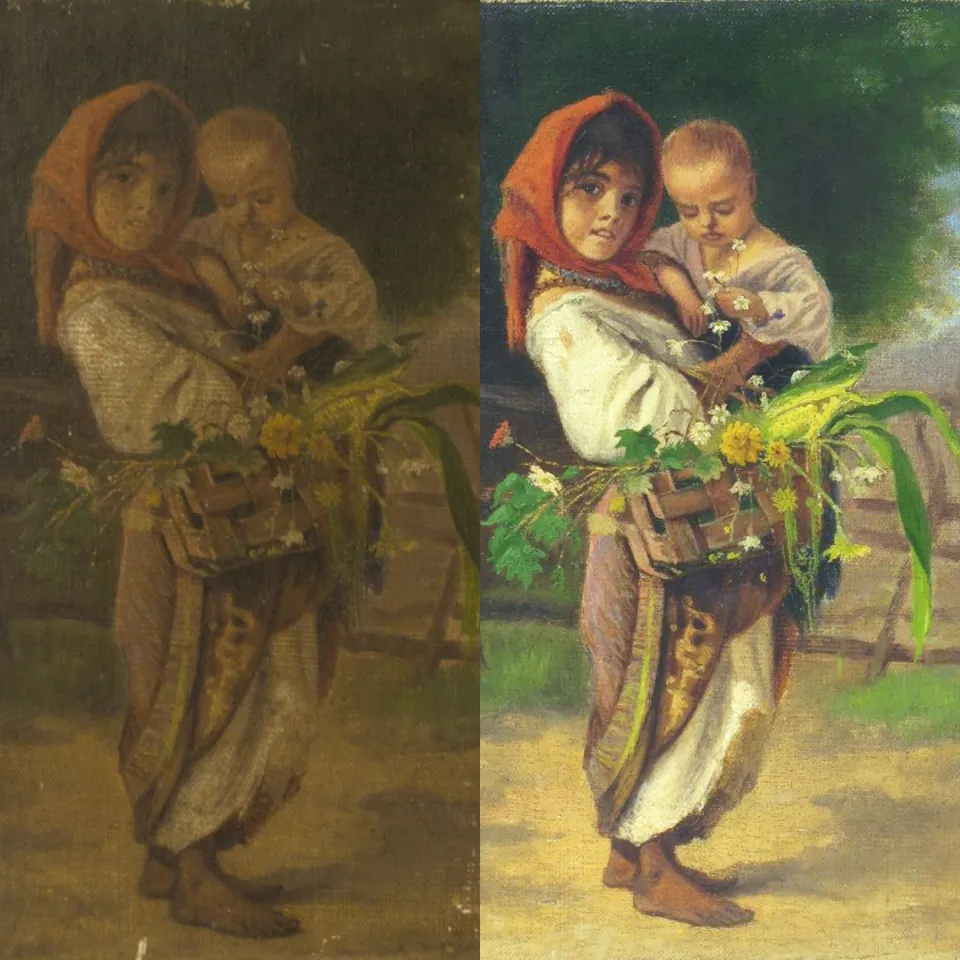
Imagine two old paintings of the same size. Both are oils on canvas, both have darkened, both have small losses, and they seem to have been painted using very similar techniques.
One may need a relatively quick, affordable treatment. The other, despite looking almost the same, may turn into a lengthy and considerably more expensive project.
The difference is not always in what you can see. It lies in how the paintings were made and what has happened to them over the decades.
A straightforward restoration is still a professional restoration
Not every artwork requires months of work. If the support is stable, the paint is well adhered, and treatment is localized, the intervention may consist of careful cleaning, repairing minor damage, filling, and reintegrating an area of loss.
I accept these kinds of projects. I do not believe a restoration has to be complicated or expensive to be worthwhile. Many owners simply want to recover a family painting and enjoy it again.
The key is not to confuse a small job done well with an apparently cheap restoration that merely disguises problems.
A different varnish can change the entire estimate
Two yellowed surfaces may look almost identical. Yet on one, the altered material may be selectively removed after straightforward tests; on the other, there may be overlapping varnishes, heavily aged resins, or overpainting mixed with the surface coating.
The challenge is not to use a “stronger” product. It is to find a system that affects the original paint as little as possible.
Some cases require progressive testing with different cleaning systems, checks under magnification, and much more working time. Sometimes we have to accept that removing an entire layer would pose too great a risk.
A visitor sees the same yellowed painting. The restorer, however, encounters two very different problems.
The ground layer may be the real problem
Beneath the paint there is usually a preparatory or priming layer that helps connect the image to its support. If that layer has lost cohesion or adhesion, cracking that looks superficial may signal a risk of flaking.
Before cleaning or retouching, the material would need to be stabilized. This may require tests with consolidants, localized application, and management of distortions in the support.
In addition, a painting made with very thin glazes may respond differently from one with a thick, robust paint layer. Two paintings in the same style do not necessarily have the same material stability.
An old repair can multiply the work
On the reverse, there may be patches, aged adhesives, weakened edges, or an earlier lining. On the surface, overpainting may cover both losses and parts of the original.
An old restoration is not inherently bad. But if those materials are failing or interfere with a new treatment, they need to be studied and may need attention.
What looked like simple retouching ends up requiring several stages: examination, consolidation, support treatment, cleaning, filling, and reintegration.
So why not quote a fixed price per square meter?
Because size does not describe difficulty. A large, stable painting may need less work than a small painting with a powdery paint layer.
That is why I separate the operations and explain which are essential, which can be postponed, and which depend on preliminary tests. If a client has a limited budget, we can consider a treatment with a narrower scope, provided it does not endanger the artwork.
I do not charge more because a painting looks valuable, or less because its artist is unknown: the estimate should reflect the actual work it needs.
If you want to understand what is happening to your painting, send me photographs of the front, the reverse, and the damage, along with its dimensions. You can request an initial assessment through my painting restoration service in Barcelona.
Alex Victor Ihnatenko