Articles
Large painting restoration for businesses, foundations, and institutions
Planning a large painting restoration in Barcelona: transport, rolling, workspace, lifting equipment, reports, invoicing, and insurance.
Message me on WhatsApp →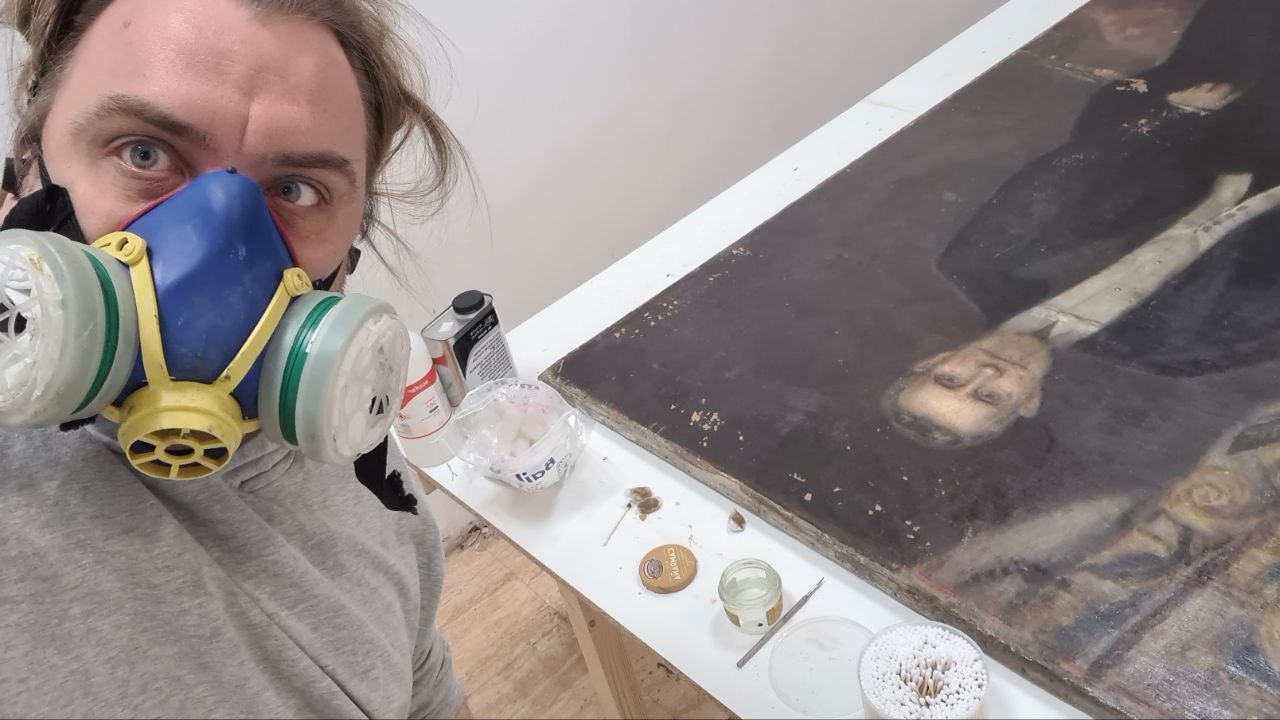
A two-meter painting already calls for careful organization of the workspace. But what happens when a church, foundation, or business needs treatment for a painting measuring 7.5 × 3.5 meters?
Restoration becomes more than a matter of cleaning and retouching. It also becomes a question of engineering, logistics, preventive conservation, contracting, and documentation. Every decision about materials has consequences.
I work with old paintings in Barcelona and have taken part in projects involving institutions, historic spaces, and businesses. When assessing a large artwork, the first question is not “How much does cleaning cost?” but “How can it be handled, transported, and treated without putting it at risk?”
Two church paintings measuring 7.5 × 3.5 meters: developing an estimate
During a consultation about two large paintings intended for a church, each measured approximately 7.5 meters high by 3.5 meters wide. Preparing an estimate on this scale requires a breakdown of items that do not arise in smaller restorations.
For example, the assessment considers renting a sufficiently large workspace—a hangar or industrial unit, if appropriate—along with environmental and security conditions, the assistants needed to move the artworks, and lifting equipment. It also considers travel, protection, packing, specialized transport, and contingencies.
If structural treatment requires a new textile support of exceptional width, it may be necessary to coordinate with a textile specialist to join sections or produce a custom canvas. It is not simply a matter of buying two rolls and sewing them together: the fabric’s compatibility, the arrangement of the joins, the stresses, and the behavior of the whole support must be assessed.
Assessing these issues in advance can turn an apparently impossible commission into a work plan with identifiable stages, costs, and risks.
An intriguing question: how do you transport a seven-meter painting?
Dismantling the stretcher may be an option for certain canvases, but transporting an old painting rolled up is not automatically safe. The stability of the paint and ground layers, the flexibility of the materials, cracking, lifting, and earlier treatments must be examined first.
When the painting’s condition allows rolling, the cylinder must have an appropriate diameter and a supporting structure that keeps the weight off the painting. Exceptional sizes may require a custom-made cylinder, surface protection, and a handling system designed for several operators.
Here is a detail that may seem counterintuitive: in general, the canvas is rolled with the painted side facing outward, not inward. This avoids compressing the paint layer on the inside of the curve. The cylinder’s radius, the painting technique, and the fragility of the layers remain crucial; a rigid painting, or one with impasto or flaking paint, may require another method of transport.
It is not enough for the roll to fit inside a vehicle, either. Access routes, doors, stairs, turning areas, loads, vibrations, and the exact unpacking location all need to be planned.
A completed project: the portrait of Rieusset’s founder
In Barcelona, I restored a portrait of Josep Rieusset, founder of the historic Rieusset S.A. factory, painted by Sangroniz in 1923. The oil painting on linen measures 210 × 125 cm.
The support was weakened, with losses and cracks, and retained earlier interventions. Two restorers had turned down the commission. To work on it, I designed a structure suited to its dimensions and arranged assistance with handling when needed.
This artwork illustrates something essential: even a format much smaller than seven meters requires specific problems to be resolved. You can read the Rieusset portrait case study.
What a foundation, business, or gallery needs to know
An organization is not just buying hours of restoration. It needs a proposal it can review internally, approve, record in its accounts, and, where appropriate, present to its insurer or the body responsible for the collection.
A professional estimate can separate:
- Diagnosis, preliminary testing, and external laboratory analysis where appropriate.
- Conservation and restoration treatments by stage.
- Rental of facilities, lifting equipment, and special materials.
- Support staff, handling, packing, and transport.
- Photographic documentation, a technical report, and delivery conditions.
- Formal invoicing, taxes, and withholding where legally applicable.
- Insurance coverage and allocation of responsibilities, according to the policies and conditions agreed upon.
Specific insurance coverage should not be assumed to be included without checking and documenting it. The same principle applies to scientific analysis: it is included in an estimate when it genuinely helps determine treatment, not as a marketing embellishment.
Restoration for institutions, offices, foundations, and nonprofits in Barcelona
A business may own a portrait of its founder, a foundation a historic collection, and a church artworks integrated into its building. They all need to preserve their heritage, but each has different access restrictions, deadlines, authorization requirements, and budgets.
My work involves examining the object and developing a viable proposal: what the painting needs, how treatment will be organized, and how it will be documented so the client knows exactly what they are commissioning.
If you manage a collection or a large painting, you can contact me with its dimensions, photographs, and general location through my painting restoration service in Barcelona. We can begin with a feasibility assessment before developing the full estimate.